Sep 16, 2026
Commercial EV Charger Troubleshooting: Why Software, Connectivity and Support Matter
Understand commercial AC charging problems, from backend compatibility and network outages to remote diagnostics, firmware updates and supplier support.
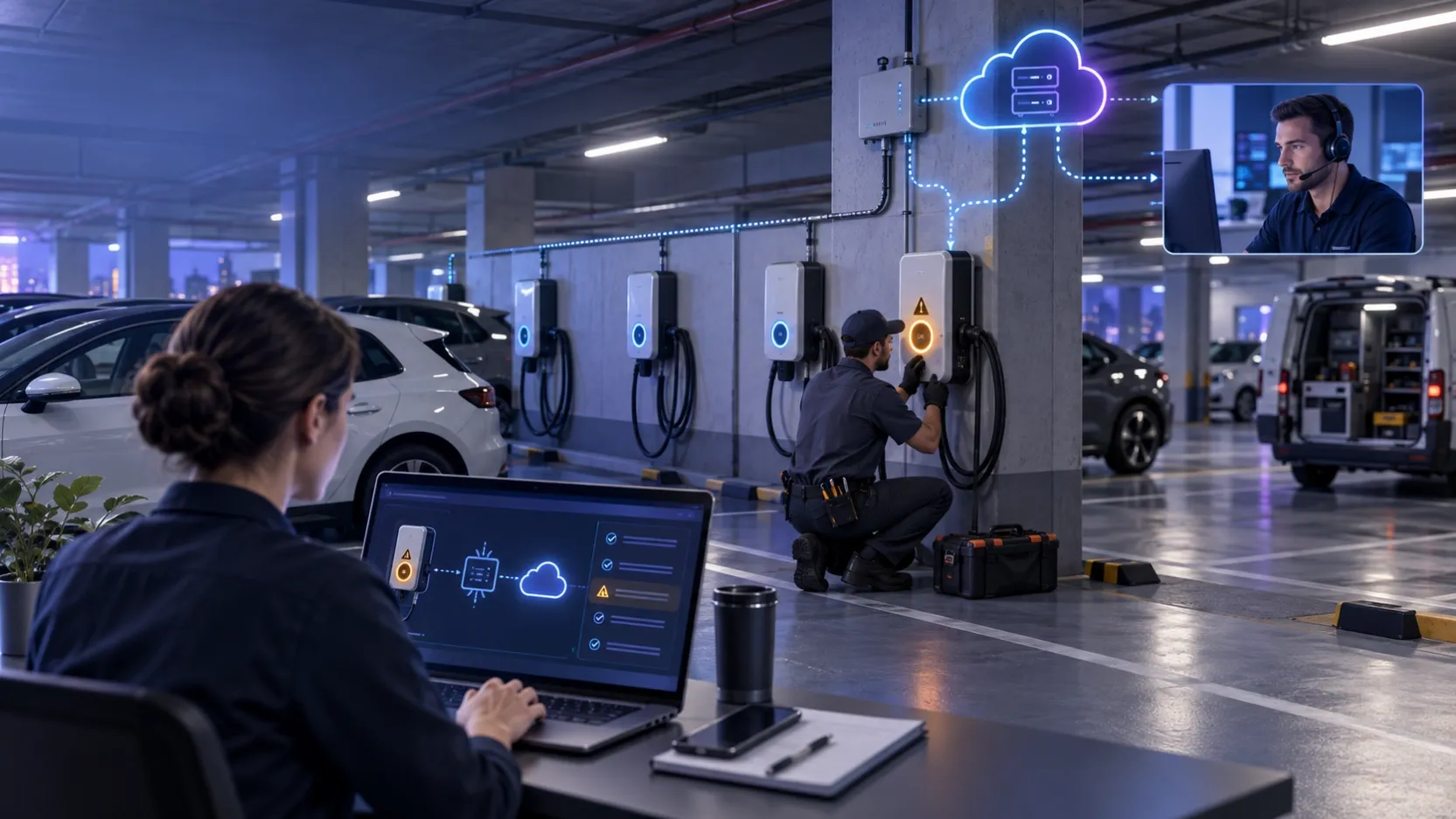
A driver plugs in, but the charging session does not start.
The charger appears offline in the management platform. A completed session is missing from the report. A remote command is sent, but nothing happens.
From the customer’s perspective, the result is the same: charging is unavailable or unreliable. For the operator, however, finding the cause requires more than assuming that the hardware has failed.
Commercial charging depends on the interaction between equipment, firmware, connectivity, software and the vehicle. The Joint Office of Energy and Transportation treats reliability as an end-to-end issue involving these interacting systems. Joint Office: charging standards and reliability
For a buyer, this makes diagnostic access and supplier support part of the product.
Separate the symptom from the cause
“Offline” is a status, not a diagnosis.
The charger may have lost power. Its local network may be unavailable. A cellular connection may have stopped working. The backend endpoint or security configuration may have changed.
Similarly, a failed session could involve authorization, a vehicle interaction, a configuration problem or a physical component.
Observed problem: Charger appears offline — Areas to investigate: Site power, local network, cellular service and backend connection
Observed problem: Driver cannot start charging — Areas to investigate: Authorization, charger status, vehicle connection and fault records
Observed problem: Charging is slower than expected — Areas to investigate: Vehicle AC limit, configured current and site power allocation
Observed problem: Session data is missing — Areas to investigate: Connectivity, timestamps, stored records and backend processing
Observed problem: Remote command fails — Areas to investigate: Connection state, supported function and command response
This table is a starting point for diagnosis. The actual cause needs evidence from the affected system.
Verify compatibility beyond the first connection
A charger appearing in a backend is only the beginning. OCPP-compatible chargers should be tested against the workflows your team will actually use.
The operating team needs reliable authorization, accurate status changes, usable energy records and predictable command responses. On a dual-port unit, the platform must distinguish the two sessions correctly.
Test these workflows before deployment. Keep the approved configuration documented so that later firmware or platform changes can be investigated against a known baseline.
Test connectivity at the parking space
A network connection that works in an office may not work equally well in a basement garage or a distant parking area.
Evaluate the intended connection where the charger will be installed. Confirm who provides the router, SIM card or network access, and who is responsible when that connection fails.
Ask the supplier to explain offline behavior:
Can an existing session continue? Can an authorized user start a new one? Are records retained and uploaded after reconnection?
The answers depend on the product and configuration. They should be demonstrated and documented.
Remote support should reduce unnecessary site visits
Ask what information the supplier can access remotely, with appropriate authorization.
Useful capabilities may include diagnostic logs, configuration checks and firmware updates. However, remote access alone does not establish that a fault can be resolved remotely.
For firmware updates, ask how the supplier validates a release, handles an interrupted update and recovers a unit that does not return to normal operation. Agree on a controlled rollout rather than updating every charger without a recovery plan.
Physical faults still require inspection and, sometimes, on-site repair.
Make on-site maintenance straightforward
When a technician must attend, the quality of the service documentation becomes important.
Can the technician identify the correct unit and fault? Are replacement parts traceable? Is the replacement procedure clear? Can the supplier explain what tests confirm that the repair is complete?
Electrical work should follow the equipment instructions and applicable local requirements. Operators should have a clear route to qualified on-site support.
Evaluate how the supplier responds
A support promise is more useful when it identifies:
- The technical contact and escalation path.
Support hours and time-zone coverage.
- The information required to open a case.
The expected first-response arrangement.
- Responsibility for hardware, backend and network investigations.
How the case is verified and closed.
A quick acknowledgment is helpful. A clear diagnosis and a workable next step are more valuable.
Frequently asked questions
Are most charging problems caused by software or the network?
That depends on the equipment and operating environment. Track your own incident data by confirmed cause instead of assuming one category dominates.
Can every problem be fixed remotely?
No. Remote diagnostics can help identify the cause and avoid some visits, but damaged components and installation faults may require on-site work.
Discuss operating support with Tiyzo
Tell us your backend, connection method, installation environment and local maintenance resources. We can discuss the diagnostic and support requirements to evaluate before deployment.