Sep 16, 2026
Commercial AC EV Chargers: What Matters Beyond Hardware Price?
Compare commercial AC EV chargers by OCPP compatibility, software flexibility, reliability, installation, maintenance and long-term operating costs.
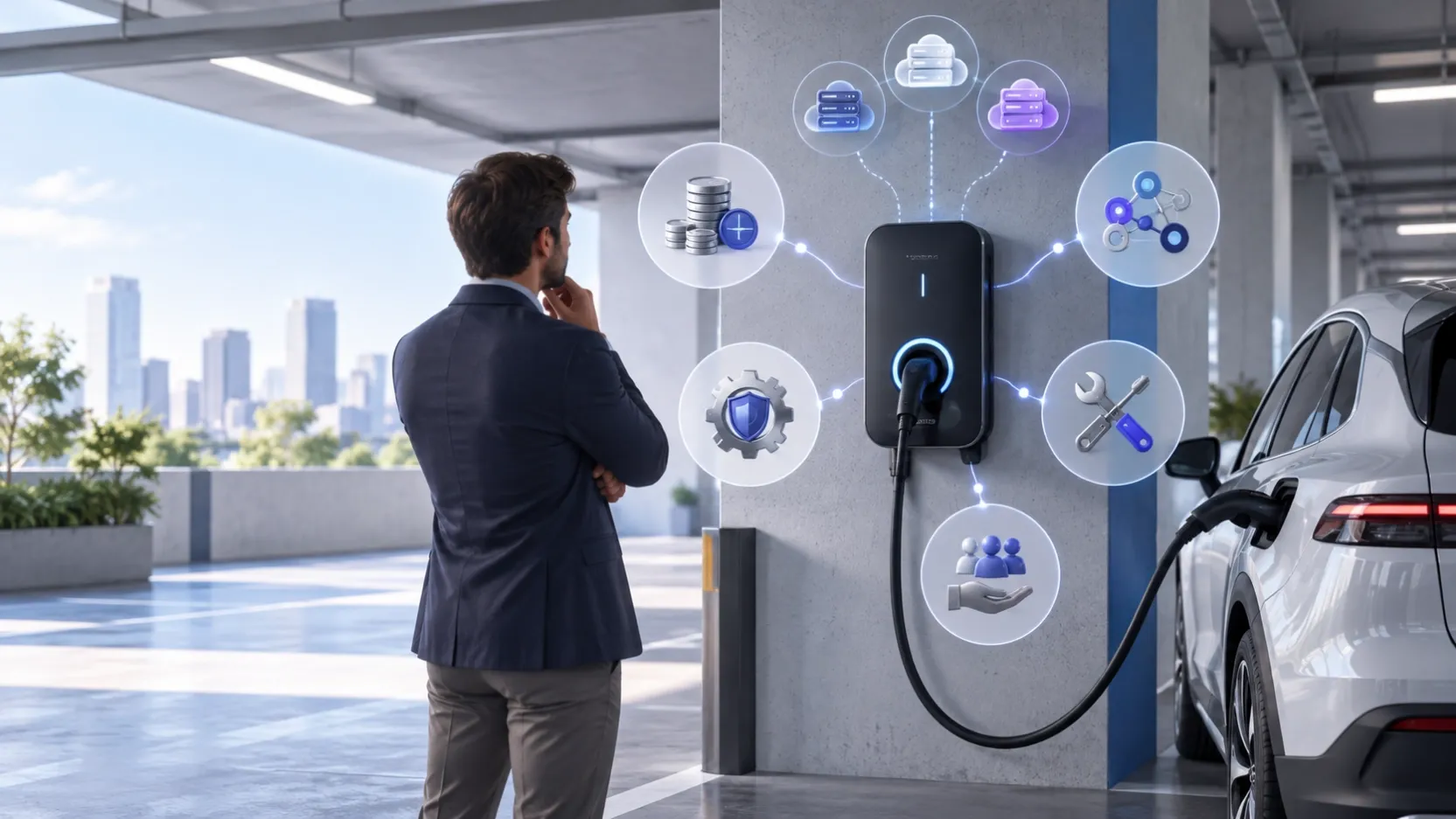
When comparing commercial AC EV chargers, buyers usually ask about price, certification, reliability, installation and maintenance.
All of these matter. However, for a networked commercial project, one question deserves attention early:
Will this hardware work with the software you want to use—and give you practical options if your needs change?
A charger can have an attractive price and a well-designed enclosure yet still create difficulties if its useful functions depend on a single software provider. For installers, distributors and charging operators, software flexibility belongs in the hardware purchasing decision.
Start with compliance, then test compatibility
First, confirm that the exact product configuration meets the requirements for its destination and intended installation. Commercial AC chargers should be evaluated as a complete system, not a price line.
Once that basic requirement is satisfied, make OCPP compatibility one of the first technical checks.
OCPP provides a communication standard between charging stations and charging management systems. It supports an open approach to connecting hardware and software, but different protocol versions and implementations still require attention. Open Charge Alliance’s OCPP overview
A supplier’s statement that a charger “supports OCPP” should lead to a demonstration on your intended platform.
Can the backend identify the charger correctly? Can a driver start and stop a session? Do energy records match? Can the platform apply the charging limits your project needs?
These are more useful questions than whether a connection was established once.
Software flexibility needs to be practical
You may be satisfied with your software provider today. Later, you may need different billing features, better reporting, another commercial agreement or a platform preferred by a new customer.
Before purchasing hardware, ask:
- Can an authorized administrator change the backend connection?
Who controls the credentials and configuration tools?
- Does changing platforms require supplier intervention or additional fees?
Which functions depend on the supplier’s own cloud service?
- What happens to historical records when the platform changes?
- If changing software is important to your business, include a migration test in the evaluation. Connecting a sample to a second selected backend can reveal restrictions that are difficult to see in a product brochure.
- Compare the factors together
- The best purchasing decision balances several requirements.
- Factor: Hardware price — What buyers should evaluate: The supplied configuration and everything excluded from the quotation
- Factor: Compatibility — What buyers should evaluate: Verified operation with the intended backend and required functions
- Factor: Reliability — What buyers should evaluate: Stable charging, recovery behavior and consistent session records
- Factor: Installation — What buyers should evaluate: Mounting, cable routing, electrical connections and commissioning
- Factor: Maintenance — What buyers should evaluate: Diagnostic access, replaceable parts and clear service instructions
- Factor: Supplier support — What buyers should evaluate: Technical ownership, response arrangements and follow-through
- A lower purchase price can still be good value. The important point is to compare complete proposals.
- A charger that requires extra installation visits, lengthy troubleshooting or an unexpected software subscription may have a different operating cost from the one suggested by its hardware price.
- Test the supplier’s technical ability
- A sample evaluation also shows how the supplier works.
- When an integration issue appears, does the supplier ask for logs, firmware details and a reproducible test? Can its technical team communicate with your backend provider? Does it explain which functions are supported and which still require development?
- A supplier that clearly defines its limitations is easier to evaluate than one that promises compatibility with everything.
- Document the approved hardware, firmware and backend configuration. If one of them changes before delivery, agree which checks need to be repeated.
- Frequently asked questions
- Does OCPP support mean a charger works with every platform?
- No. Verify the protocol version, implemented functions and actual operation with your chosen backend.
- Should price be the deciding factor?
- Price matters after you establish that the proposed equipment can meet your operating requirements. Compare installation, software and service costs alongside it.
- Is the supplier’s own software a problem?
- Not necessarily. It may suit your project well. What matters is understanding your options, dependencies and costs before committing.
- Discuss your commercial AC requirements with Tiyzo
- Tell us your project location, preferred backend, charging requirements and installation plan. We can review the available hardware options and identify the compatibility checks needed before you place an order.
-